Sensory Overload after a braininjury in multiple languages.
(Sensory Overstimulation
Sensory hypersensitivity )
We would like to explain something about sensory overstimulation / sensory hypersensitivity /sensory overload after braininjury / Acquired Brain Injury in as many languages as possible.
Choose the language that suits you best from the menu below:























Sensory overload following brain injury is a neurological condition that may occur when the brain’s processing capacity and functional reserve are reduced. As a result, amounts of sensory, cognitive, and emotional information that could previously be processed may exceed the brain’s available capacity.
Sensory overload following brain injury may result in paroxysmal neurological and cognitive symptoms. These may represent a temporary worsening of existing symptoms or the temporary emergence of symptoms that were previously absent or not noticeable. Examples include transient weakness, speech difficulties, balance disturbances, or cognitive dysfunction. However, any new acute neurological deficit should always prompt evaluation to exclude a new cerebrovascular event, such as a stroke.
!! New or sudden neurological symptoms should always be medically assessed to exclude other causes, such as a new stroke.!
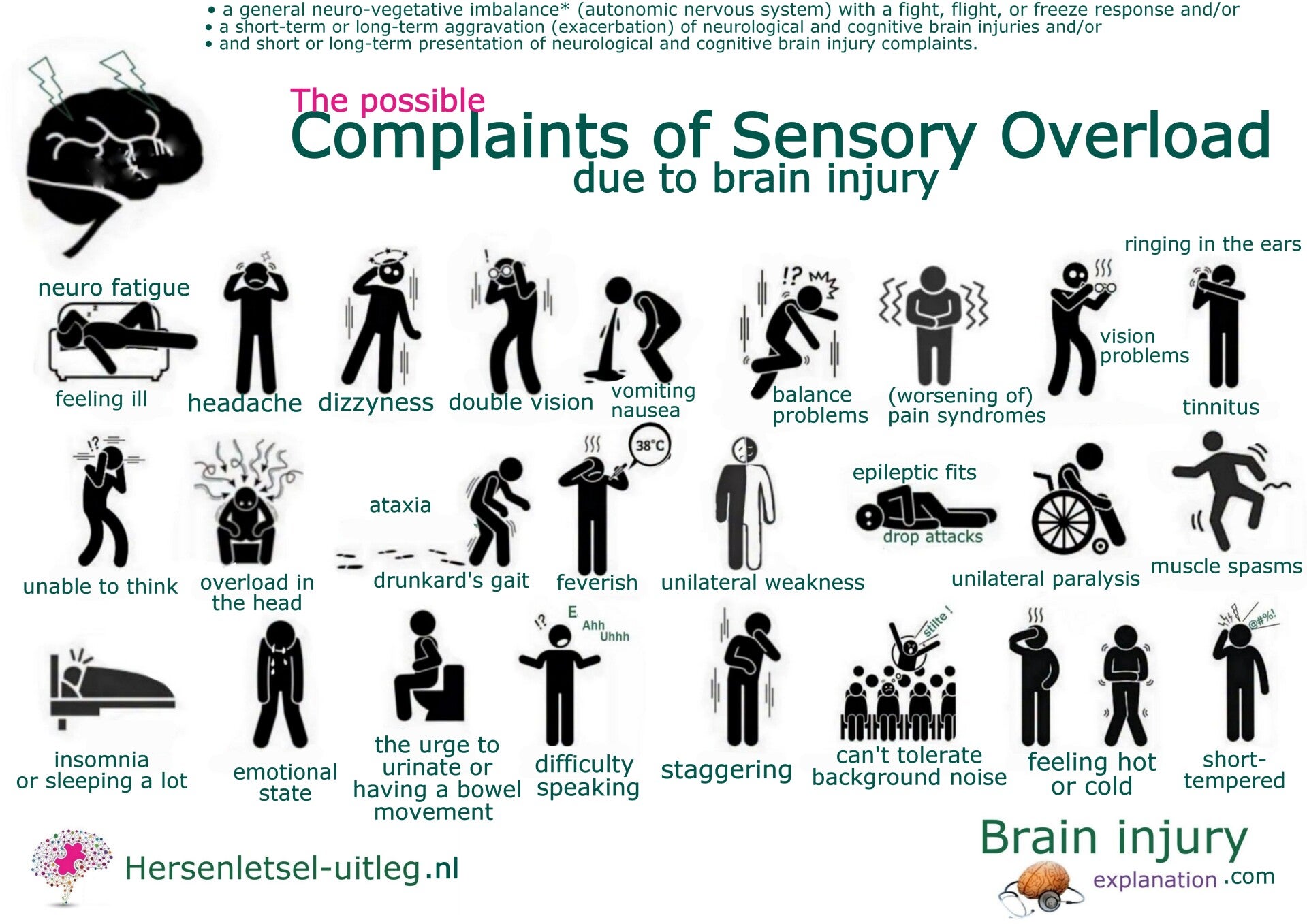
The image below shows all the (possible) symptoms resulting from sensory overload that were identified in our scientific research
Research
The results of our scientific research are published.
You can already translate the text of the PDF into your language with Google Lens.
DEFINITION
Based on the research the definition of ‘Overstimulation due to Brain Injury’ has been further refined. This has resulted in the following definition:
Sensory Overstimulation due to brain injury is a condition characterised by an exhausting situation of neurological origin, which arises when more cognitive, emotional and sensory (including proprioceptive and vestibular) information (in the form of stimuli) is received than the brain can process.
This can result in:
- general neurovegetative imbalance* (autonomic nervous system) involving a fight, flight or freeze response and/or
- a short-term or long-term aggravation / exacerbation of neurological and cognitive brain injury symptoms and/or
- a short-term or long-term manifestation of neurological and cognitive brain injury symptoms.
There may be single complaints or combinations of neurovegetative, neurological, cognitive or emotional brain injury complaints
The severity of the complaints can fluctuate depending on the number of stimuli and whether or not stacked stimuli and varying daily energy. The severity of the complaints can differ individually and can be influenced by the location and severity of the brain injury, general physical and mental condition, personality characteristics, developmental or anxiety disorders and in particular also additional disorders of the senses, which may or may not develop acutely or develop slowly and for example medication use.
.
* definition of neuro-vegetative complaints = symptoms of the disease that can arise when the nervous system that independently (unwillingly) takes care of the control of various organs is disrupted.
The 25 possible symptoms
1. Neurofatigue
2. Headache
3. Dizziness
4. Double vision
5. Nausea / vomiting
6. Balance problems
7. Worsening pain syndromes
8. Difficulty seeing
9. Tinnitus / ringing in the ears
10. Inability to think
11. Feeling of a full head
12. Ataxia (‘unsteady gait’)
13. Slight rise in temperature / feeling feverish
14. Loss of strength on one side of the body
15. Epileptic seizure / drop attacks
16. Loss of strength / weakness
17. Convulsions / muscle spasms
18. Inability to sleep or sleeping too much
19. Emotional
20. Urge to urinate or have a bowel movement
21. Inability to speak (properly)
22. Unable to understand anything when in company
23. Feeling hot or cold
24. Feeling irritated / Angry
25. Experiencing a shutdown of the body and brain
General symptoms
- Sudden, pronounced fatigue with a need for prolonged recovery.
- A feeling of complete exhaustion.
- Fatigue that can progress to extreme exhaustion.
- Slightly elevated body temperature.
Neurological symptoms
- Headache (varying in intensity).
- A feeling of a tight band around the head.
- A pressure sensation in the head.
- Epileptic seizures.
- Increased heart rate, rapid breathing, or episodes of breathing pauses.
- Tremor, muscle stiffness, and an increased risk of falls.
- Frequent blinking and/or closing the eyes.
- Nausea or vomiting.
- Temporary facial weakness/paralysis.
- One-sided weakness/paralysis, numbness in the affected side, or reduced movement/coordination of that side.
- Short-lasting loss of consciousness or a change in the level of awareness.
- Reduced ability to coordinate movements.
- Reduced ability to speak clearly (speech articulation problems).
- Sudden urgent need to urinate, have a bowel movement/defecate, or diarrhea.
Cognitive symptoms
- Difficulty taking part in a conversation due to sensory overload/overstimulation.
- Difficulty finding the right words.
- Stuttering or stammering.
- Trouble thinking clearly and experiencing slow thinking.
- Reduced ability to concentrate.
Emotional and behavioral symptoms
- Increased irritability or aggressive behavior.
- Being more emotionally affected than usual.
- Hyperactivity or an unusually increased level of activity.
- Crying easily or becoming tearful due to exhaustion.
In 2019, we received the Gold medal of honor for particularly good work for people with brain injuries.
