
English version
The results of a scientific research are published at:
o https://www.overprikkeling.com/onderzoek-overprikkeling
o https://www.hersenletsel-uitleg.nl/onderzoek-overprikkeling
Through scientific research into sensory overload in cases of brain injury, we have been able to identify a clinical picture.
Sensory overload following brain injury is a neurological condition that may occur when the brain’s processing capacity and functional reserve are reduced. As a result, amounts of sensory, cognitive, and emotional information that could previously be processed may exceed the brain’s available capacity.
DEFINITION of the clinical picture of Sensory Overstimulation
Based on research, the definition of ‘Sensory Overstimulation due to Brain Injury’ has been further refined. This has resulted in the following definition:
Overstimulation due to brain injury is a condition characterised by an exhausting situation of neurological origin, which arises when more cognitive, emotional and sensory (including proprioceptive and vestibular) information (in the form of stimuli) is received than the brain can process.
It can result in:
• general neuro-vegetative imbalance* (autonomic nervous system) with a fight, flight, or freeze response and/or
• a short-term or long-term aggravation (exacerbation) of neurological and cognitive brain injuries and/or
• and short or long-term presentation of neurological and cognitive brain injury complaints.
There may be single complaints or combinations of neurovegetative, neurological, cognitive or emotional brain injury complaints
The severity of the complaints can fluctuate depending on the number of stimuli and whether or not stacked stimuli and varying daily energy. The severity of the complaints can differ individually and can be influenced by the location and severity of the brain injury, general physical and mental condition, personality characteristics, developmental or anxiety disorders and in particular also additional disorders of the senses, which may or may not develop acutely or develop slowly and for example medication use.
.
* definition of neuro-vegetative complaints = symptoms of the disease that can arise when the nervous system that independently (unwillingly) takes care of the control of various organs is disrupted.
Soffos Scientific Research Institute, Dr M. Schüsler, Dr J.A.P. van Haastrecht and A. van Schaaijk—contributing expertise in neurology / lecturer
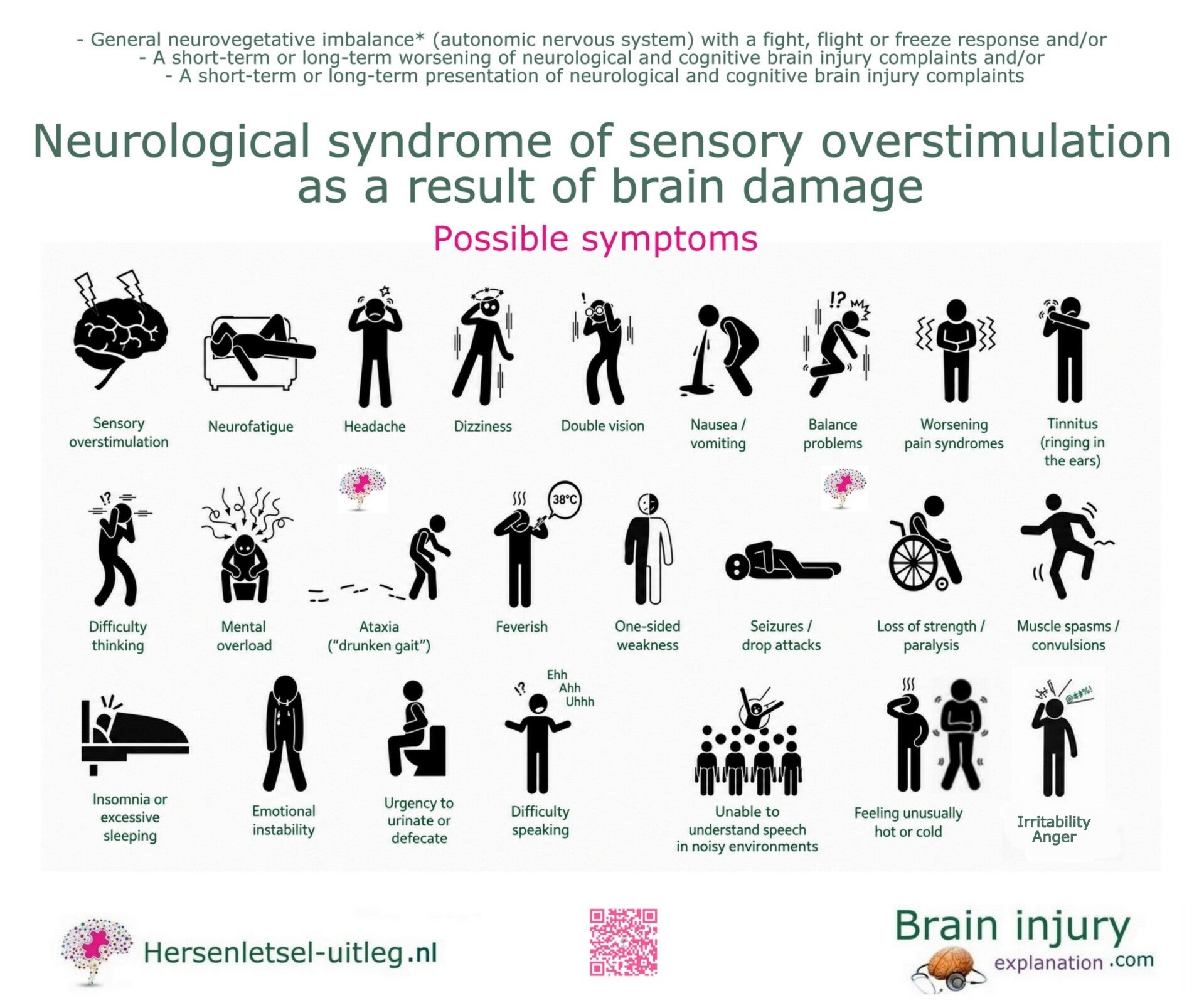
The possible symptoms of sensory overstimulation
(We found more symptoms, see the results of our research)
- Neurofatigue
- Headache
- Dizziness
- Double vision
- Vision problems/ difficulty seeing
- Nausea / vomiting
- Balance problems
- Worsening pain syndromes
- Tinnitus / ringing in the ears
- Inability to think
- Feeling of a full head
- Ataxia (‘unsteady gait’)
- Slight rise in temperature / feeling feverish
- Loss of strength on one side of the body
- Epileptic seizure / drop attacks
- Loss of strength / weakness
- Convulsions / muscle spasms
- Inability to sleep or sleeping too much
- Emotional/ crying
- Urge to urinate or have a bowel movement
- Inability to speak (properly)
- Unable to understand anything when in company
- Feeling hot or cold
- Feeling irritated / Angry
- Experiencing a shut down from the brains and the body
General symptoms
- Sudden, pronounced fatigue with a need for prolonged recovery.
- A feeling of complete exhaustion.
- Fatigue that can progress to extreme exhaustion.
- Slightly elevated body temperature.
Neurological symptoms
- Headache (varying in intensity).
- A feeling of a tight band around the head.
- A pressure sensation in the head.
- Epileptic seizures.
- Increased heart rate, rapid breathing, or episodes of breathing pauses.
- Tremor, muscle stiffness, and an increased risk of falls.
- Frequent blinking and/or closing the eyes.
- Nausea or vomiting.
- Temporary facial weakness/paralysis.
- One-sided weakness/paralysis, numbness in the affected side, or reduced movement/coordination of that side.
- Short-lasting loss of consciousness or a change in the level of awareness.
- Reduced ability to coordinate movements.
- Reduced ability to speak clearly (speech articulation problems).
- Sudden urgent need to urinate, have a bowel movement/defecate, or diarrhea.
Cognitive symptoms
- Difficulty taking part in a conversation due to sensory overload/overstimulation.
- Difficulty finding the right words.
- Stuttering or stammering.
- Trouble thinking clearly and experiencing slow thinking.
- Reduced ability to concentrate.
Emotional and behavioral symptoms
- Increased irritability or aggressive behavior.
- Being more emotionally affected than usual.
- Hyperactivity or an unusually increased level of activity.
- Crying easily or becoming tearful due to exhaustion.
Sensory Overload Following Brain Injury (ABI/TBI): Neurological Symptoms and Scientific Findings
Sensory overload following a Brain Injury is a complex neurological condition that may occur after an **Acquired Brain Injury (ABI)**, including **Traumatic Brain Injury (TBI)**, stroke (CVA), brain tumour, hypoxic brain injury, encephalitis, or other forms of brain injury. Following brain injury, the brain may have difficulty processing excessive amounts of sensory, cognitive, and emotional information. Everyday stimuli such as noise, bright light, multiple conversations, crowded environments, or rapidly changing situations may exceed the brain's processing capacity, resulting in sensory overload and severe **Neurofatigue**.
Common symptoms of sensory overload include headaches, dizziness, concentration difficulties, increased sensitivity to sensory stimuli, emotional changes, mental exhaustion, and reduced ability to function in daily life.
**However, scientific findings indicate that sensory overload may also temporarily worsen pre-existing neurological and cognitive symptoms. In some individuals, these changes may persist for a longer period. Sensory overload may also temporarily trigger neurological or cognitive symptoms that were previously absent or not noticeable. For example, some people may experience temporary or longer-lasting unilateral weakness, neurological deficits, reduced muscle strength, speech difficulties, vomiting, balance disturbances, seizures, or other neurological changes during or after a period of sensory overload.**
These neurological and cognitive symptoms may occur in a **paroxysmal** (episodic or transient) manner. The severity and duration of symptoms vary between individuals and may be influenced by the location and severity of the brain injury, physical and mental condition, available energy, cumulative sensory stimulation, stress, and recovery capacity.
The aim of this information, together with the underlying scientific research, is to increase worldwide awareness of sensory overload after Brain Injury and to support people living with **Acquired Brain Injury (ABI)**, **Traumatic Brain Injury (TBI)**, stroke, and other neurological conditions, as well as their families and healthcare professionals, in understanding this often under-recognized neurological phenomenon and its impact on daily functioning and quality of life.
This information is based on scientific findings and is written in clear, accessible language while maintaining medical accuracy. Every person with a Brain Injury experiences sensory overload differently, and the type, severity, duration, and combination of symptoms may vary considerably between individuals.
**Important:** New, sudden, or unexpectedly severe neurological symptoms—such as sudden weakness on one side of the body, new speech difficulties, loss of consciousness, or seizures—should always be assessed promptly by a medical professional to exclude other causes, including a new stroke (CVA) or another acute neurological condition.
In 2019, we received the Gold medal of honor for particularly good work for people with brain injuries.